
Trash Bag Thickness Guide: Microns and Mil Explained
Trash bag thickness is the number buyers ask about first, yet it is quoted in two different units — microns in most of the world and mil in the United States — and the two are easy to confuse.
This guide explains what each unit measures, gives exact conversions and a ready-made table, and shows why thickness alone does not decide how strong a bag is. It ends with a checklist for writing thickness into a purchase specification, so that quotes from different suppliers can be compared line by line. If you are sourcing private label or bulk garbage bags, the same logic applies to every product in our trash bag range.
1- What microns and mil actually measure
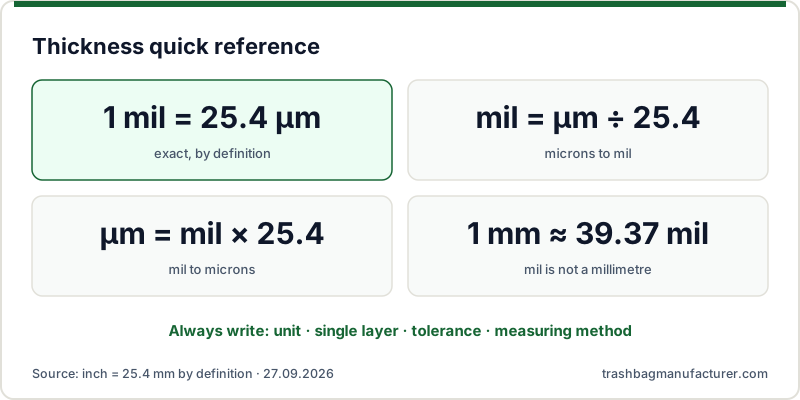
Both units measure the thickness of the plastic film the bag is made from. A micron — properly a micrometre, written µm — is one thousandth (1/1000) of a millimetre. A mil is one thousandth of an inch; engineers outside North America often call the same unit a thou. Because the inch is defined as exactly 25.4 mm, one mil is exactly 25.4 µm.
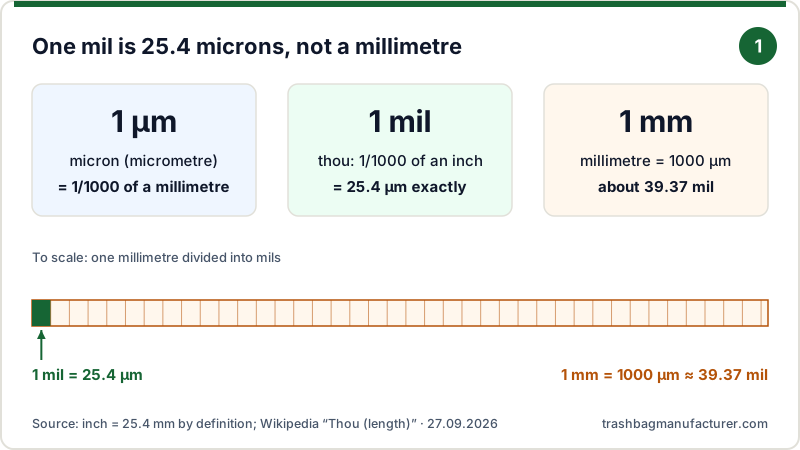
The trap is the name. In everyday speech “mil” is also short for millimetre, and a millimetre is far larger than a mil: 1 mm is 1000 µm, or about 39.37 mil. A buyer who reads “1.5 mil” as 1.5 mm is off by a factor of almost forty. The definition of the thou or mil and the NIST guidance on unit conversion are the references we use for every figure in this guide.
Some markets also quote plastic film in “gauge”. Gauge definitions differ between countries, so we convert any gauge figure into microns in writing before we quote. The same caution applies to figures given as a weight per bag or per roll: weight is useful for checking a delivery, but it is not a thickness.
2- How to convert microns to mil and back
The conversion is a single division or multiplication by 25.4, with no rounding needed until the final figure:
- mil = microns ÷ 25.4 — for example, 30 µm ÷ 25.4 = 1.18 mil.
- microns = mil × 25.4 — for example, 1.5 mil × 25.4 = 38.1 µm.
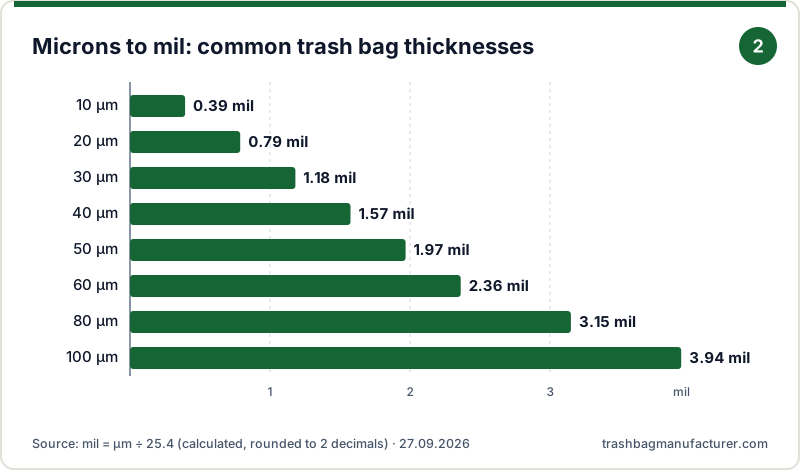
| Microns | Mil |
|---|---|
| 10 µm | 0.39 mil |
| 20 µm | 0.79 mil |
| 30 µm | 1.18 mil |
| 40 µm | 1.57 mil |
| 50 µm | 1.97 mil |
| 60 µm | 2.36 mil |
| 80 µm | 3.15 mil |
| 100 µm | 3.94 mil |
Going the other way, from mil to microns, the most common US figures convert as follows:
| Mil | Microns |
|---|---|
| 0.5 mil | 12.7 µm |
| 0.7 mil | 17.78 µm |
| 1.0 mil | 25.4 µm |
| 1.5 mil | 38.1 µm |
| 2.0 mil | 50.8 µm |
| 3.0 mil | 76.2 µm |
| 4.0 mil | 101.6 µm |
A quick mental check: every 10 microns is a little under 0.4 mil, and every mil is a little over 25 microns. If a quoted figure fails that check, ask which unit it is in before you compare prices.
3- Why thickness alone does not decide strength
Two bags with the same thickness can behave very differently in a bin, because the resin matters as much as the gauge. According to reference data on high-density polyethylene, HDPE has a tensile strength of about 38 MPa against about 21 MPa for low-density polyethylene (LDPE): its molecules are less branched and pack more tightly. That is why a thin HDPE bag can lift a surprising load.
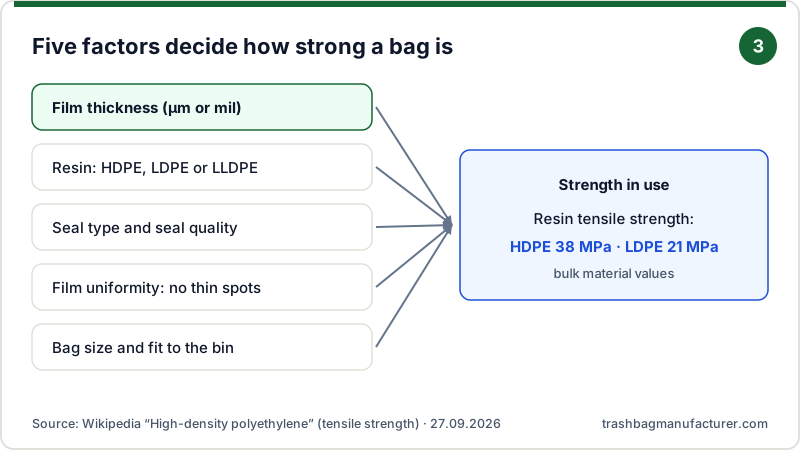
Tensile strength is not the whole story. LDPE is more ductile — it stretches before it fails — and linear low-density polyethylene (LLDPE) combines higher tensile strength with higher impact and puncture resistance than LDPE, as the LLDPE reference notes. For waste with sharp corners, a film that stretches around the point is often more useful than a stiff film that is strong until it is pierced.
Three more factors complete the picture:
- Seal type and seal quality. A flat seal, a star seal and a drawstring hem each spread the load differently, and a weak bottom seal makes film thickness irrelevant.
- Film uniformity. A bag is only as strong as its thinnest spot, so consistent extrusion matters more than a higher nominal figure.
- Size and fit. A bag that is too small for the bin is stretched before it is filled; a bag that is far too large folds and snags.
Our guide to HDPE vs LDPE garbage bags covers the material choice in detail.
4- How to match thickness to the waste and the bin
There is no single correct thickness. The right figure depends on what goes into the bag, how full it gets and how it is handled after it leaves the bin. As a working rule, move up in thickness — or switch to a more stretchable film — as waste gets heavier, wetter or sharper.
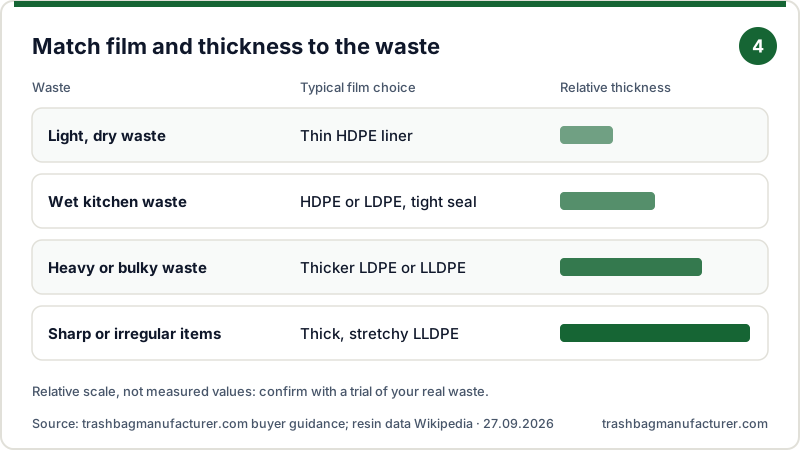
- Light, dry waste such as office paper is where thin HDPE liners are most often used.
- Wet kitchen waste needs a leak-tight seal first and a sensible thickness second; both HDPE and LDPE bags are used.
- Heavy or bulky waste calls for thicker LDPE or LLDPE film that can take the weight when the bag is lifted.
- Sharp or irregular items, such as renovation debris or broken packaging, need the thickest and most stretchable film in the range — the heavy duty and industrial end of our product list.
Fit matters as much as film. For a round bin, the flat width of the bag should be about half the bin's circumference, and the length should cover the bin's depth plus enough film to reach across the base and fold over the rim. For a square or rectangular bin, use half the perimeter instead of half the circumference. Measure the bin you actually use rather than relying on its nominal volume.
The most reliable method is a trial: fill bags of two or three thicknesses with your real waste, lift and carry them the way your staff do, and choose the thinnest one that passes. Ask us about trial bags when you request a quote.
5- How to write thickness into a purchase specification
Most disputes about thickness come from specifications that leave room for interpretation. A line that only says “30 micron bags” can be read in several ways, so write down each of the following points:
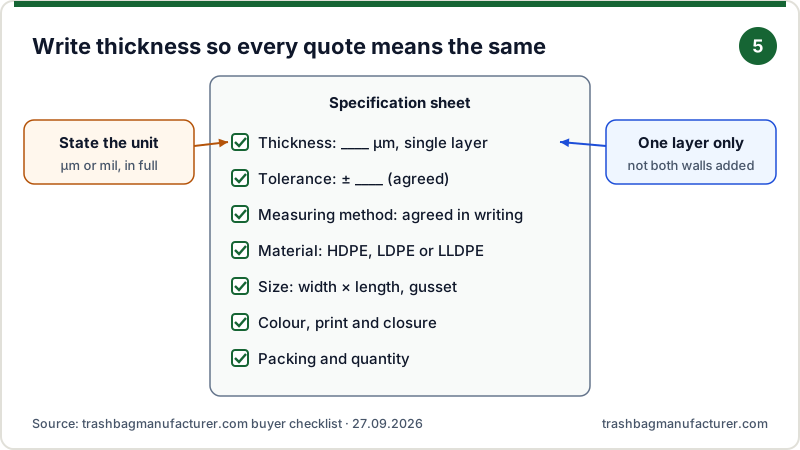
- Unit. Microns or mil, written in full — never an abbreviation that could be read as millimetre.
- Single layer or total. A flat bag has two walls. State that the figure refers to a single film layer; a figure that adds both walls doubles the number without adding any plastic.
- Nominal value and tolerance. Agree an acceptable range around the nominal figure with your supplier, and how many readings an average is based on.
- Measuring method. Agree where on the bag the film is measured and with which instrument, so that your incoming inspection and the factory's own checks can be compared.
- Material. HDPE, LDPE, LLDPE or a blend — see how to specify the material.
- Size and construction. Flat width × length, any gusset, and the closure: drawstring, flat seal or star seal.
- Colour, print and packing. Film colour, any private label print, bags per roll or per box, and cartons per pallet.
Some buyers also specify weight — grams per bag or bags per kilogram. It is a useful cross-check because weight follows directly from size, thickness and density, as the next section shows. For private label programmes the same sheet becomes the reference document for your private label brief.
6- How thickness drives bag weight, cost and loading
Film is bought by weight, so thickness feeds straight into the resin cost of every bag. For a flat bag without gussets, the weight in grams is weight (g) = 2 × width (m) × length (m) × thickness (µm) × density (g/cm³). The factor 2 counts the two walls; one square metre of film one micron thick has a volume of one cubic centimetre, which is why the units line up. The example below uses a 60 × 80 cm flat bag and a density of 0.92 g/cm³.
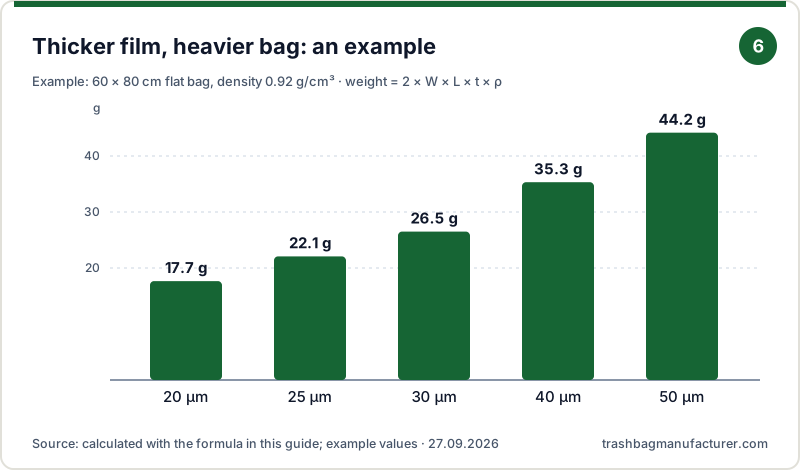
| Thickness | Bag weight |
|---|---|
| 20 µm | 17.7 g |
| 25 µm | 22.1 g |
| 30 µm | 26.5 g |
| 40 µm | 35.3 g |
| 50 µm | 44.2 g |
In this example the bag weight rises in direct proportion to thickness: a 40 µm bag weighs 1.6 times as much as a 25 µm bag of the same size. The density of 0.92 g/cm³ is an example value inside the LDPE range of 0.910–0.940 g/cm³ given in the polyethylene density classification; HDPE is denser, at 0.941 g/cm³ and above.
Two practical consequences follow. First, compare quotes per bag — or per thousand bags — at the same specification, not only per kilogram, because a lower price per kilo on a thicker film can still cost more per bag. Second, thicker bags take more space and weight per carton, which changes how many bags fit in a container. When you plan full container loads — our export capacity is about two 40' HC containers per month today — ask for the packing plan together with the quote.
Frequently asked questions
Short answers to common thickness questions from importers, distributors and private label buyers.
Is 1 mil the same as 1 millimetre?
No. One mil is one thousandth of an inch, which is 25.4 µm or 0.0254 mm. One millimetre is about 39.37 mil, so reading “mil” as millimetre overstates the thickness almost forty times.
How do I convert microns to mil?
Divide the micron figure by 25.4. For example, 50 µm ÷ 25.4 = 1.97 mil. To convert mil to microns, multiply by 25.4.
Why can a thin HDPE bag feel stronger than a thicker LDPE bag?
HDPE has a higher tensile strength than LDPE — about 38 MPa against 21 MPa for the bulk materials — so a thinner HDPE film can carry a similar load. LDPE and LLDPE stretch more, which helps with sharp or bulky waste.
Do you manufacture custom thicknesses?
Yes. We produce trash bags in any size, thickness and colour. Send your target thickness in microns or mil together with the size and material, and the factory confirms the specification in writing with the quote.
Should thickness be measured on one layer or on both walls?
On one film layer. Write this into the specification: a figure that adds both walls of a flat bag is twice as large without the bag being any stronger.
Ready to compare? Send us your specification, contact us with questions, read our other trash bag buying guides, or go back to the home page.